Device Descriptor Request Failed – Why It Happens & How to Fix It
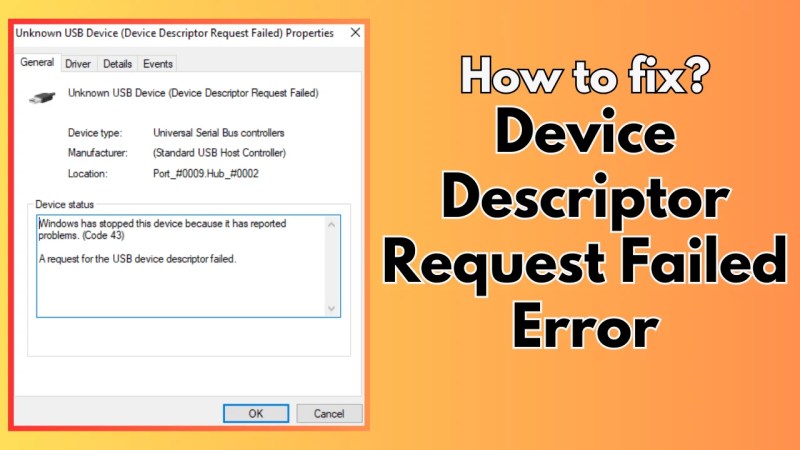
The moment your system spits out "device descriptor request failed" is the moment panic sets in. One second, your USB drive, printer, or webcam was working flawlessly; the next, Windows, macOS, or Linux refuses to recognize it, leaving you staring at an unreadable error in Device Manager or `dmesg`. This isn’t just a minor glitch—it’s a communication breakdown between your OS and the device, often rooted in hardware, driver corruption, or protocol mismatches. The error typically manifests when the OS attempts to fetch the device’s descriptor—a critical data packet that defines its capabilities, vendor ID, and supported protocols. Without it, the system defaults to a "safe mode" of operation, disabling the peripheral until the issue is resolved.
The frustration deepens when standard fixes—unplugging and replugging, updating drivers—fail to work. That’s because "device descriptor request failed" isn’t a one-size-fits-all problem. It can stem from a faulty USB port delivering inconsistent power, a corrupted driver stack, or even a device firmware bug. The error’s persistence across operating systems (Windows, Linux, macOS) suggests a fundamental incompatibility, often tied to USB 2.0/3.0/4.0 protocol quirks or power management settings. Ignoring it risks permanent data loss on storage devices or hardware damage if the system keeps retrying failed handshakes.
For developers, IT professionals, and power users, this error is more than an annoyance—it’s a diagnostic puzzle. The descriptor request failure disrupts the USB communication stack at the enumeration phase, where the OS queries the device’s identity before assigning resources. Unlike generic "device not recognized" messages, this specific error pinpoints the exact failure point: the handshake between the host controller and the peripheral. Understanding its nuances—whether it’s a power draw issue, a driver conflict, or a hardware defect—is the first step toward a permanent fix.

The Complete Overview of "Device Descriptor Request Failed"
At its core, "device descriptor request failed" is a USB protocol error that occurs during the device enumeration process, a critical phase where the operating system identifies and configures a connected peripheral. When you plug in a USB device, the host controller (built into your motherboard or chipset) initiates a sequence of requests to retrieve the device’s descriptor data—a structured packet containing metadata like vendor ID, product ID, supported speeds (e.g., USB 2.0 vs. 3.2), and power requirements. If this request fails, the OS cannot proceed, leaving the device in a limbo state where it’s detected but unusable.The error’s persistence across platforms—whether it’s "USB device not recognized" in Windows, "device descriptor read/64, error -110" in Linux’s `dmesg`, or "This accessory may not be supported" on macOS—hints at a systemic issue. Unlike transient errors (e.g., a loose connection), this failure often indicates a hardware incompatibility, driver corruption, or power management conflict. For example, a high-power device (like an external SSD) might draw more current than a USB 2.0 port can provide, triggering a descriptor fetch failure. Similarly, a corrupted driver or a firmware bug in the device itself can disrupt the handshake, leaving the OS unable to read the descriptor.
Historical Background and Evolution
The USB specification has evolved significantly since its introduction in 1996, but the "device descriptor request failed" issue remains a perennial problem due to backward compatibility challenges. Early USB 1.1 devices, designed for low-speed peripherals, often struggled with higher-speed ports (USB 2.0+) because of mismatched power delivery or protocol quirks. As USB 3.0 and later standards introduced SuperSpeed and SuperSpeed+, the complexity of the enumeration process grew, with additional descriptor types (e.g., SS Capability Descriptor) required for proper handshaking. This added layer of complexity meant that even minor firmware flaws or driver misconfigurations could trigger descriptor fetch failures.Linux, in particular, has historically been more verbose in logging these errors, with messages like "usb 1-1: device descriptor read/64, error -110" (indicating a timeout or communication failure) appearing in `dmesg`. Windows, meanwhile, often masks the technical details behind user-friendly (but unhelpful) prompts like "One of the USB devices attached to this computer has malfunctioned". The rise of USB-C and Thunderbolt 3/4 further exacerbated the issue, as these interfaces combine multiple protocols (USB, DisplayPort, PCIe) under a single connector, increasing the chances of descriptor-related conflicts.
Core Mechanisms: How It Works
The USB descriptor request failure occurs during the three-stage enumeration process:1. Address Assignment: The host controller assigns a temporary address to the device.
2. Descriptor Fetch: The OS sends a GET_DESCRIPTOR request to retrieve the device’s identity (e.g., vendor ID, product ID).
3. Configuration: Based on the descriptor, the OS allocates resources (bandwidth, power) and loads drivers.
Table of Contents
- The Complete Overview of "Device Descriptor Request Failed"
- Historical Background and Evolution
- Core Mechanisms: How It Works
- Key Benefits and Crucial Impact
- Major Advantages
- Comparative Analysis
- Future Trends and Innovations
- Conclusion
- Comprehensive FAQs
- Q: Why does "device descriptor request failed" appear only on one USB port?
- Q: Can a corrupted driver cause this error even if the device worked before?
- Q: What does "error -110" in Linux’s `dmesg` mean?
- Q: Will a USB hub fix this issue if the port is faulty?
- Q: Can a firmware update for my device resolve this error?
- Q: Is there a way to force Windows to retry the descriptor request?
- Q: Why does this error occur more often with external SSDs?
- Q: Can macOS handle this error differently than Windows or Linux?
If the GET_DESCRIPTOR request fails—due to a timeout, CRC error, or invalid response—the OS halts enumeration, leaving the device in an unrecognized state. Common triggers include:
Debugging tools like USBlyzer, Wireshark, or Linux’s `lsusb -v` can reveal whether the issue lies in the physical layer (cable/port) or the logical layer (driver/firmware).
Key Benefits and Crucial Impact
Understanding and resolving "device descriptor request failed" isn’t just about restoring functionality—it’s about preventing data loss, hardware degradation, and system instability. For businesses relying on USB peripherals (e.g., POS systems, industrial scanners), this error can translate to downtime, lost transactions, or equipment failure. Even for consumers, the stakes are high: an unrecognized external drive could mean irrecoverable data loss if the OS keeps retrying failed handshakes, overheating the port.The error also serves as an early warning sign for deeper issues. A recurring descriptor failure on a specific port may indicate electrical degradation (e.g., a failing motherboard USB controller). Similarly, if multiple devices trigger the same error, it could point to a driver stack corruption or a firmware regression in the OS. Addressing it proactively can save hours of troubleshooting later.
"USB descriptor errors are the canary in the coal mine of hardware diagnostics. They don’t just signal a failed connection—they often reveal systemic flaws in power delivery, driver integrity, or protocol compliance."
— USB Implementers Forum (USB-IF) Technical Advisory
Major Advantages
Resolving "device descriptor request failed" offers tangible benefits:- Data Recovery: Prevents permanent loss of files on storage devices by halting repeated failed handshakes.
- Hardware Longevity: Reduces stress on USB ports and controllers by avoiding power surges from failed negotiations.
- System Stability: Eliminates kernel panics or driver crashes caused by unrecognized devices.
- Compatibility Expansion: Allows legacy devices to work with modern systems by adjusting power management settings.
- Diagnostic Insight: Reveals deeper hardware/software issues (e.g., faulty cables, driver bugs) before they escalate.
Comparative Analysis
| Scenario | Likely Cause | Recommended Fix ||----------------------------|------------------------------------------|---------------------------------------------|
| USB 2.0 Device on USB 3.0 Port | Protocol mismatch (device not negotiating proper speed) | Use a USB 2.0-compatible hub or disable USB 3.0 in BIOS. |
| High-Power Device (e.g., SSD) | Insufficient port current (5V/900mA limit) | Use a powered hub or enable "USB Power Sharing" in Windows. |
| Driver Corruption | Partially installed or outdated driver | Roll back drivers, use Device Manager’s "Update Driver" or reinstall from scratch. |
| Faulty Cable/Port | Intermittent connection or damaged pins | Test with a known-good cable/port or use a USB analyzer to check signal integrity. |
| Linux `dmesg` Error -110 | Timeout during descriptor fetch | Adjust `usbcore.autosuspend` settings or disable USB autosuspend in kernel parameters. |
Future Trends and Innovations
As USB evolves toward USB4 v2.0 and Thunderbolt 4, the "device descriptor request failed" error may become less frequent due to improved power negotiation (USB Power Delivery) and faster enumeration protocols. However, the rise of USB-C’s multi-protocol role (combining USB, DisplayPort, and PCIe) introduces new descriptor complexities. Future fixes may involve:For now, manual troubleshooting remains essential, but the shift toward USB4’s 80Gbps speeds and Thunderbolt’s unified protocol could reduce descriptor-related issues by standardizing power and handshake procedures.
Conclusion
"Device descriptor request failed" is more than an error message—it’s a symptom of deeper technical challenges spanning hardware, drivers, and protocols. While the immediate fix often involves basic troubleshooting (driver updates, port testing), the root cause may require deeper diagnostics, especially in enterprise or high-reliability environments. The key is to isolate whether the issue is physical (cable/port) or logical (driver/firmware) before escalating to hardware replacement.For end users, the takeaway is simple: don’t ignore the error. A failed descriptor request can lead to data corruption, hardware wear, or system instability, but with systematic debugging, most cases resolve without permanent damage. As USB technology advances, these errors may become rarer, but for now, understanding their mechanics remains a critical skill for anyone reliant on USB peripherals.
Comprehensive FAQs
Q: Why does "device descriptor request failed" appear only on one USB port?
A: This typically indicates a hardware defect in that specific port (e.g., damaged pins, insufficient power delivery). Test the port with a known-working device, or check for physical damage. If the issue persists, the port may need replacement or BIOS-level reconfiguration (e.g., disabling USB 3.0 if the port is USB 2.0-only).
Q: Can a corrupted driver cause this error even if the device worked before?
A: Yes. Driver corruption—often from a failed update or conflicting software—can send malformed GET_DESCRIPTOR requests, causing the OS to reject the device. Use Device Manager (Windows) or `lsmod` (Linux) to identify and reinstall the driver. Booting into Safe Mode may help if the driver is part of a larger conflict.
Q: What does "error -110" in Linux’s `dmesg` mean?
A: In Linux, "error -110" (ETIMEDOUT) indicates a timeout during descriptor fetch, meaning the device failed to respond within the expected timeframe. This can stem from:
Q: Will a USB hub fix this issue if the port is faulty?
A: Not necessarily. If the root port (the one connected to your motherboard) is defective, the hub will inherit the same problem. However, a powered hub can sometimes bypass power delivery issues if the original port lacks sufficient current. Test with a different hub or port to isolate the problem.
Q: Can a firmware update for my device resolve this error?
A: Absolutely. Many descriptor failures are caused by firmware bugs in the device itself (e.g., webcams, adapters, or external drives). Check the manufacturer’s website for updates, or use tools like Zadig (for driver reflashing) or libusb (for low-level firmware tweaks). Some devices even require DFU (Device Firmware Update) mode to fix descriptor-related issues.
Q: Is there a way to force Windows to retry the descriptor request?
A: Yes, but it’s risky. You can:
1. Uninstall the device in Device Manager, then restart (Windows will retry enumeration).
2. Use a third-party tool like USBDeview to reset USB stack settings.
3. Modify the registry to adjust USB timeout values (advanced users only; back up first).
Note: Forced retries may worsen hardware stress if the root cause is physical (e.g., a failing port).
Q: Why does this error occur more often with external SSDs?
A: External SSDs often require higher power (900mA+) and USB 3.0+ speeds, making them sensitive to:
Q: Can macOS handle this error differently than Windows or Linux?
A: Yes. macOS often masks the technical details behind messages like "This accessory may not be supported", but the underlying cause is the same: a failed descriptor request. Solutions include:
Leave a Comment
Comments are moderated before appearing. The data you submit is processed according to the Privacy Policy of Coolearth.